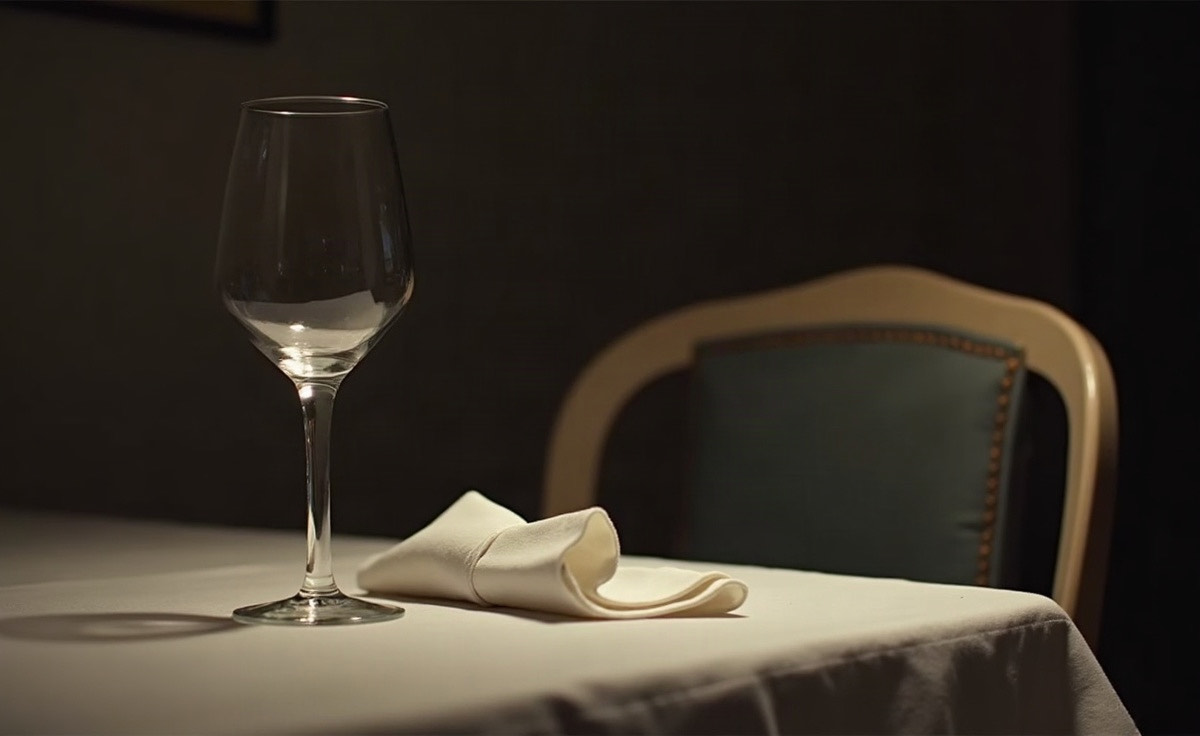
It comes at the table, usually between courses, usually from somebody who loves you.
"So! Any news?" Or the direct version, which is somehow easier: "When are you two having kids?" And everybody looks up, because everybody heard, and now the room is waiting and you have about a second and a half.
Here is what to say, in each of the situations you might actually be in.
The all-purpose answer
If you want one sentence that works in every case and closes the subject without a scene:
"We'll let you know if there's ever anything to tell."
Warm tone, then reach for something on the table. It is polite, it answers nothing, and it puts the next move on them. Most people take it.
If they push, repeat it. Do not improve it. The second version of a boundary is the same as the first version or it was not one.
When you are trying and it is not working
You do not owe this to a dinner table, and telling it as a way of stopping the question usually makes the question worse, because now it becomes a topic people ask about with a sympathetic head tilt.
"That's a bigger conversation than dinner. Ask me another time."
That does two things. It signals there is something without opening it, and it moves the person from public curiosity into private care, which is where you can actually decide whether you want to say more.
To the person you would tell:
"We've been trying for a while and it's been hard. I'll tell you when there's news. Please don't ask me in front of people."
The last sentence is the one that matters and the one people forget to say.
When you have lost a pregnancy
You are allowed to say nothing at all. Silence with a small smile is a complete answer, and anyone who keeps pushing past it has told you something about themselves.
If you want words:
"That's not something I can talk about tonight."
Say it evenly. Nobody in the history of dinner has followed that sentence with another question.
When you are not having children
This is where people give too much and end up defending a decision that was never up for review.
"We're not planning to."
Full stop. Do not add "because", because the "because" is what gets argued with. If you say you want to travel, you will hear about people who travel with children. If you say you cannot afford it, you will hear that nobody can. The reason is the handle.
When it is followed by "you'll change your mind":
"Maybe. Either way it's not a decision I'm making at dinner."
When it is followed by "but you'd be such a good mother":
"Thank you. Still not planning to."
When it is your mother, again, for the ninth time
At some point this stops being a question at a dinner and becomes a pattern, and a pattern needs a different conversation on a different day, alone, calmly:
"I know you want this for me. When you ask, it makes me not want to talk to you about my life. I need you to stop asking, and I'll tell you if anything changes."
Then hold it. She will ask again within two months, and the whole thing rests on what you do then:
"I meant it. Let's talk about something else."
What not to say
Don't joke. "Ha, ask my husband!" is a door, and somebody will walk through it and ask your husband, in front of you.
Don't lie about timing. "In a couple of years" sounds like an escape and is a diary entry. They will remember, and in a couple of years you will be having the same conversation with a receipt.
Don't explain in a group. Whatever you say to eleven people at a table becomes something eleven people discuss when you leave the room.
What it costs
The cost is that somebody who loves you feels shut out, and they are not entirely wrong that they have been.
That is the trade. You are choosing to be slightly less known by them in exchange for not being asked to account for your body over dessert. For most people, most of the time, that is a good trade, and it is worth making deliberately rather than sliding into it after the fourth time you left a dinner in a bad mood.
What you get is the version of the evening where the question comes, and it lands on a wall, and the conversation moves on, and you eat your food.
One story and one script, once a week
No advice you have read before, and nothing we would not say to a friend at our own kitchen table.
The list opens shortly. We would rather have nowhere to put your address than pretend to collect it.